

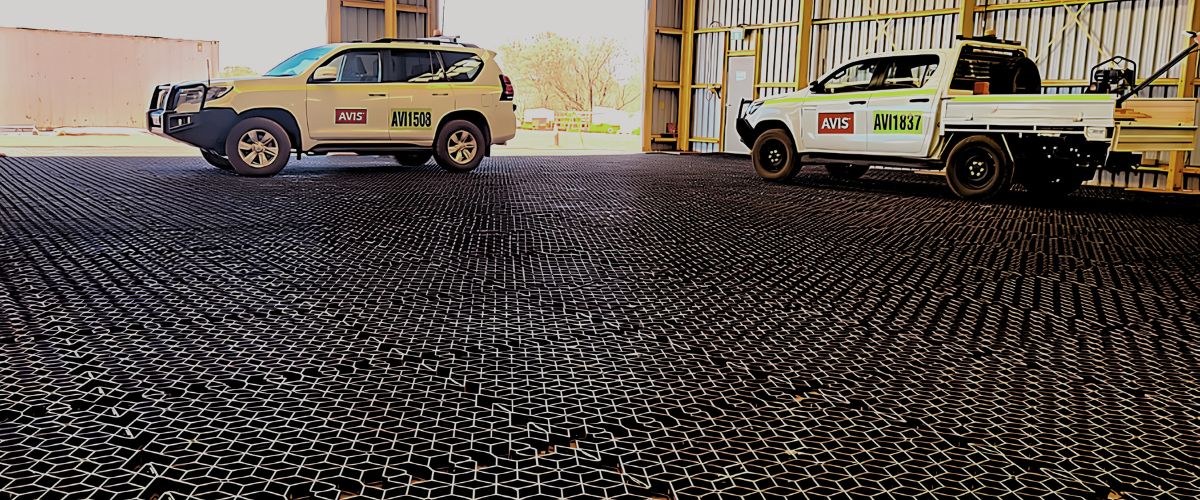
Why Large-Scale Industrial Sites Are Rethinking Traditional Concrete Construction
Rio Tinto’s Hope Downs 4 mine site in the Pilbara required a sealed warehouse floor solution that could withstand the demands of a remote mining environment while reducing dust, maintenance, and operational disruption.
Traditional flooring methods such as reinforced concrete and asphalt presented significant cost and performance challenges, particularly due to high mobilisation costs and ongoing wear from heavy vehicle traffic.
The site implemented Rombus, an innovative flexible concrete pavement system designed specifically for demanding industrial and mining applications.
Business: Rio Tinto – Hope Downs 4
Industry: Mining & Heavy Vehicle Infrastructure
Location: Pilbara, Western Australia
Project: 1,640m² Warehouse Floor
Product: Rombus Flexible Concrete Pavement System
The Challenge
The existing warehouse required a durable sealed floor that would minimise dust and eliminate loose gravel while standing up to heavy machinery and workshop traffic.
Challenges Included:
- Traditional reinforced concrete required a 250mm thick slab, making it extremely expensive in a remote location.
- Concrete costs in the Pilbara could exceed $1,000 per cubic metre.
- Asphalt was not suitable due to premature wear caused by wheel screwing and heavy vehicle movements.
- Extensive mobilisation of machinery and materials would significantly increase project costs and downtime.
- The site needed a practical solution that could be installed quickly without compromising durability.
The Solution
The completed warehouse floor delivered substantial operational, financial, and environmental benefits for the Rio Tinto site.
Why the Rombus System Was Selected:
- Designed to perform in remote mine site conditions
- Built to handle heavy machinery and workshop traffic
- Reduced the need for major earthworks and extensive mobilisation
- Delivered a long-lasting sealed surface using significantly less concrete
- Faster installation compared to traditional concrete construction methods
Key Features:
- Flexible concrete pavement technology
- Never thicker than 4cm
- Built for heavy industrial applications
- Manufactured using recycled Australian polypropylene grid technology
The Result
The completed warehouse floor delivered substantial operational, financial, and environmental benefits for the Rio Tinto site.
Major Cost Savings
Approximately $480,000 saved by eliminating:
- Removal and disposal of 574m³ of material
- Importation and construction of a traditional sub-base
- Pouring 420m³ of conventional concrete
Instead, the project required only:
- 64m³ of concrete
- 1,680m² of Rombus Grid
Reduced Carbon Footprint
- More than 127,008kg of carbon emissions avoided
- Additional emissions savings achieved by reducing large-scale earthworks and material transport requirements
Sustainability Benefits
- 9,072kg of recycled plastic utilised
- Rombus Grid is manufactured from 100% recycled Australian polypropylene
Reduced Downtime
- Warehouse floor operational in just 17 days
- Included only 7 days curing time
- Approximately 20 days of downtime saved compared to traditional methods
Rio Tinto’s Hope Downs 4 Mine Site
“By dramatically reducing concrete volume, mobilisation requirements and installation time, the Rombus system provided Rio Tinto with a smarter, more economical heavy-duty flooring solution.
Thank you
United Ag recognises Rombus Industries for sharing this project and the proven results achieved at Rio Tinto’s Hope Downs 4 mine site. This case study highlights how smarter pavement technology can help large-scale industrial operations reduce cost, downtime and material use without compromising performance.
For more information about how the Rombus Flexible Concrete Pavement System can transform your industrial flooring project, please contact United Ag or visit or website - www.unitedag.com.au
Published February 2026